
December 2025
I am contained by multitudes

And you'd say you love me and look in my eyes
But I know through mine you were looking in yours

("Last Words of a Shooting Star,"  Mitski)
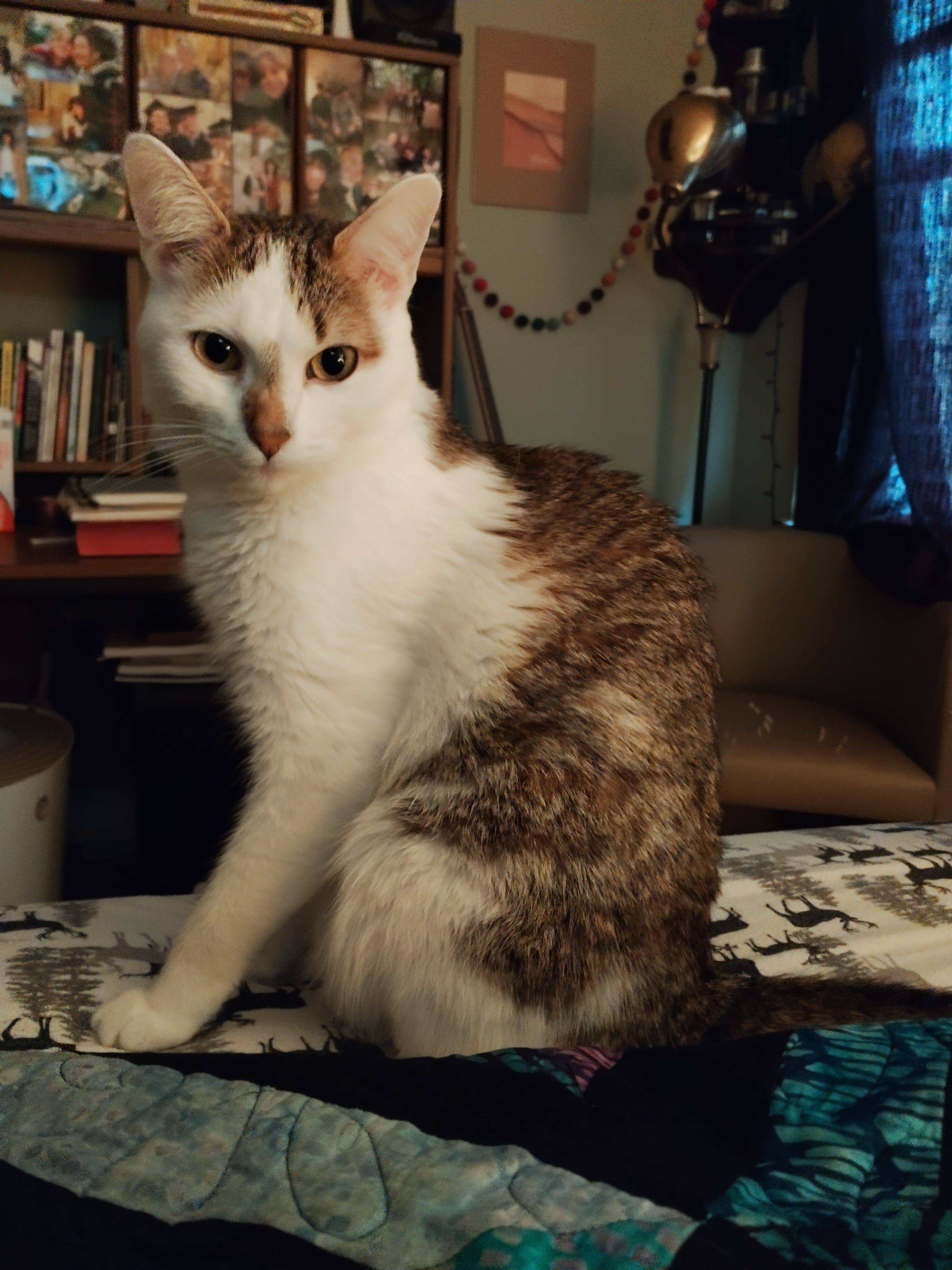
I am lying in bed, clutching Binky close to my chest as she purrs, staring into her eyes. It’s dark outside—that strange syrupy darkness that makes itself known as the season turns, when darkness shifts from a fact of the day to a force, maybe a Being, you now have to reckon with. The space heater is humming on my desk. The string lights dangling from my ceiling are sparkling. It is winter.
Binky and I share this precious ability to stare at each other. She trusts me enough to let me hold her close for a long while, and often in these moments we will lock eyes together, her pupils just as wide as I imagine mine to be. There is a drifting, a presence in these moments. Narrative stops a little, context dims, and, for a second—just a second—it is just us. Staring.
Today, the light catches in Binky’s eyes as we stare, and I notice its reflection, as I sometimes do. I can see my lamp in her pupils, glowing in the corner of my room. And next to it I can see myself, looking at her, turning my head back and forth to double-check that what I’m seeing is real. Her eyes are tiny mirrors, it seems. I realize, suddenly, that the image I see reflected in her eyes is, in a literal, material way, exactly what she is seeing. The image caught in the lens. The thinnest barrier between us. It is the most obvious fact—it is the very structure of the moment—and yet somehow it is the most precious and shocking truth. Binky is looking at me. Binky is seeing me.
I don’t recognize her, the woman in the mirror. It is strange to witness her. I know what she consists of—I am her material—but I am not her. Yet she is me.
In a class I took with SJ this summer, I arrived at a question that has been quietly haunting me for months…
What pieces of yourself aren’t contained within your subjectivity?
The idea of the self feels so tenuous, even as it is so obvious. That I am I and you are you. It’s hard for me to conceive of a more fundamental structure, so much so that the quality of these vessels—the Subject and the Object—and their interconnectedness (or lack thereof) is a central facet of nearly every belief system I can think of, from Buddhism to Solipsism, from Creationism to Material Determinism. The ways we chose to relate to the structures of the Self and the Other are definitional to how we interact with the world. I don’t name this to attempt any insight towards the “correct” way to conceive of your Self—you already have your own practiced relationship with this, because you are a human—rather, I want to point towards the tenuousness of the Self as a possible place of beginning. Countless art, countless theory, countless politics, endless relation, all begins from this questioning of what feels like the most basic premise. What am I to you, and what are you to me? How does, how can, how should, how must a self—a Subject (a being that is perceiving)—relate to an other—an Object (what or who is being perceived)? What separates them? What conjoins them?
What Binky’s eyes pull me towards today is the idea of the Reflection as a relational structure: the image of the self returned to itself, mediated by an Object. In the most simple example of a this—the Mirror—a person (the Subject) looks into a mirror (the Object) and receives back a physical image of themself, a representation of them that is completely beholden to their presence, but inarguably distinct from their personhood. The person and the reflection of that person are identical, but crucially are not the same: one is a being, the other is an image of that being. But there is so much that the Subject can learn about themselves from the presence of the reflection—information that was already present, but is now able to reach them from a new perspective and affect them in a way it previously couldn’t. You might now notice a hair out of place, a stain on your shirt, or maybe you suddenly find yourself reacting to your own beauty when confronted with an image of it. The reflection allows the Subject to react to itself as an Object, to consider itself from outside its own perspective and respond to the information it gleams by witnessing itself. In the case of the Mirror, there is a premise of transparency—a mirror returns an exact, identical image rendered visually. Its existence is one of precision, it does not interpret or alter the image it receives. But there are many more reflections we receive than just those from mirrors. What about the images of ourselves that are more biased, more colored, more subjective—what about the reflections of ourselves we receive from other beings?
This is what strikes me so intensely, while staring into Binky’s eyes: seeing my visual reflection in her eyes forces me to remember that Binky is perceiving me, that she experiences the world in just as much constant visceral detail as I do, even if it’s harder for her to relate these experiences to me without a shared, spoken language. She knows me, she remembers how I treat her, she cares how I treat her, and she changes how she acts around me based on how I’ve acted towards her recently—just as would be true for any two beings in relationship. I see my visual reflection when I stare into Binky’s eyes, yes, but I also receive my relational reflection. The way she treats me is a mirror—colored by her subjectivity—of my own behavior. Knowing Binky allows me to know a version of myself.
Again, this is no more or less true in my relationship with Binky than it is in my relationship with anyone—to know each other is to reflect each other. But the version of me that Binky sees and reflects back is distinct from most of my relationships because her understanding of me is so inhuman, in that word’s most literal meaning. Binky does not see me as human, because Binky has no concept of humanity. There is no frame, no thought-in-language for her to place me inside of. There is no precedent, there is no understanding. There is maybe a memory, far off, in the body of her mother or her mother’s mother, of a pattern, a relationship like this one, a friendship with a bigger person who brought her food, but its song is soft and its promise sparse. Above all, there is no certainty provided by any structure—only the certainty born of our relationship. She is not seeing an idea, she is seeing me. And I am large. So large. Impossibly large. I am gentle, but powerful, to a degree that is scary. I am still, I am watching, enwrapped in our shared silence. I am a feeling that doesn’t have a name. What she sees is so far beyond my comprehension, so void of every structure I have been taught to know myself through, and yet is so precisely me—formed by every moment we’ve shared. Me, utterly and undeniably.
And suddenly I am split in two. The Jane that Binky knows is so starkly different than the Self that I occupy; if Binky were to describe me and I were to describe myself, the portraits we’d paint would be unrecognizable, but each no less true than the other. Which of these two is “the real me?” Is my understanding of myself any more “correct” than her understanding of me? What if I am my self-perception and Binky’s understanding of me? Obviously I am contained within both of these structures, but what does that mean to my experience of myself? I can only experience myself from my own perception, but Binky is not interacting with my perception, she is interacting with me, and the me that she knows is radically different from the me that I know. What if the Jane that I understand and the Jane that Binky understands are fundamentally different people? This woman that Binky knows, that she loves… who is she to my Self? To the me that I understand? That I perceive from and live from? If my reflection is not me, then who is she?
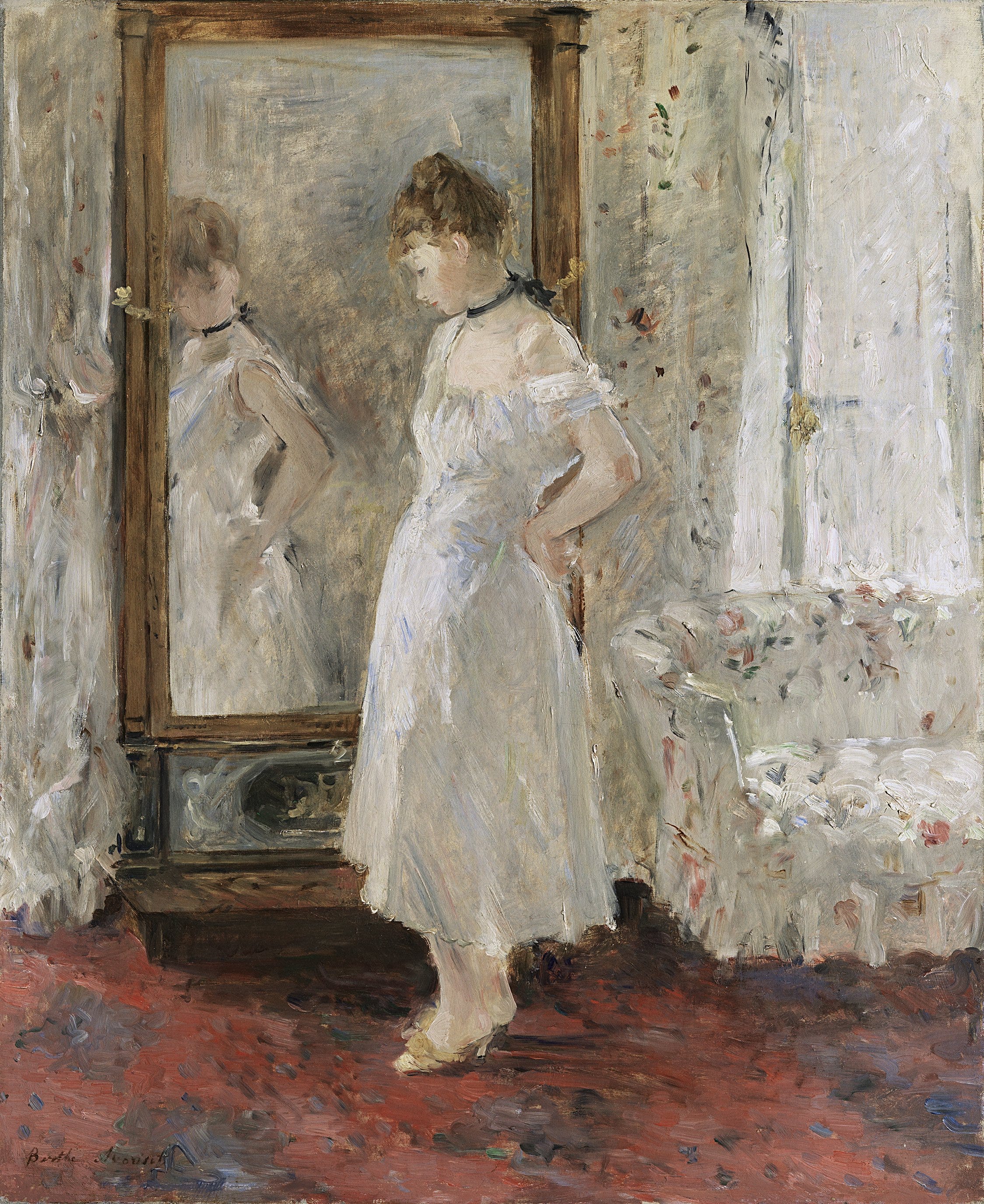
It’s a dissociative project to take this question seriously. There is a fragmentation spiraling outward from it—if each relational reflection of myself is another being, something about my self-concept has to fracture. Obviously Binky is not the only one who perceives me. So do you. And so does everyone I have ever met. And suddenly Jane is no longer Jane, but something of a fractal, one point within a functionally infinite web of the versions of myself that exist within the eyes of others. Which, at least initially, feels like it stands in opposition to my desire in asking this question. Binky and I share a deep intimacy, she sees sides of me no one else gets to (except Annabelle, I guess, but she’s not laying on my chest right now). If she knows me so genuinely, shouldn’t her perspective of me help me know myself better? But no, I feel fragmented. I do want to take this question seriously, though. There is such a wide gap between my self-perception and others’ perceptions of me—what if, to know myself better, I have to begin by admitting that I don’t know myself as well as I maybe think I do? Who is this woman that I’m seeing in the mirror? Maybe I’ve begun in the wrong direction. It’s hard to meet Binky’s Jane because, although Binky and I share so much intimacy, there is so much else we don’t share that makes communicating our shared knowing challenging. What if I begin again?
Anna and I often stare into each others eyes, too, as lovers must. And I am in her eyes, as well. There is a Jane she knows that I do not. And the Jane that she knows is much, much more recognizable to me than the Jane that Binky knows, but in the subtlety of our differences she is oh so much harder to look at. Binky has no concept of humanity, but Anna and I very much share one. We were raised in the same culture, we speak the same language, we understand ourselves and each other through the same shared lens. But the images filtered through that lens are so, so very different. Binky sees my reflection. Anna sees my doppelgänger.
The Jane that Anna seems to know—the doppelgänger—is confident, self-assured to the degree of propulsion. She is talented, and generous with her talent, reaching outward to share it whenever give then chance. She is ambitious, she works to put her ideas into practice and leaves beauty in her wake, constantly looking forward toward future possibility. And she is kind, and gentle, and sincere, and supportive. She speaks the firm truths she need to, even though it isn’t always easy for her to do. She knows herself, she trusts herself. She is childlike in her wonder and forward with her feeling. She shares. At every opportunity she shares, all that she can. She is soft. She is strong. She is beautiful. She is wise.
And just as before, Anna is correct. She couldn’t be anything other than correct. This is me. So precisely me. An image formed by every moment we have shared. An understanding formed by exactly how I have shown up in our relationship. And, very importantly, this is a reflection of myself that I have access to—Anna shares her with me. By knowing Anna, by our intimacy, I am gifted my reflection, the most magnificent, propulsive reflection of myself.
But oh, oh how this is not my Self. This is not the Jane I perceive from, nor act from. This is is not the Jane that I get to experience.
And maybe there’s very good reason for this, on both the level of explanation and the level of purpose. I have so much more context for my life than Anna does. I know myself better—I know my history, I know my pattens, I know my mistakes. I know the harm I’ve caused. I know the pitfalls and the hang-ups and the paralyzing fears. And I know the quiet glow that lives behind it all, breathing through it. Maybe I shouldn’t be able to set all of it aside, maybe it is the vital, crucial context that creates, that is creating the Jane that Anna gets to meet, that allows me to move through the world as (hopefully) my healthiest self, because I know what my unhealth looks like, and feels like, and I know how it shows up, and I know the harm it brings with it. I understand why my doppelgänger isn’t my self.
But what if it could be?
What if I could perceive from my reflection?
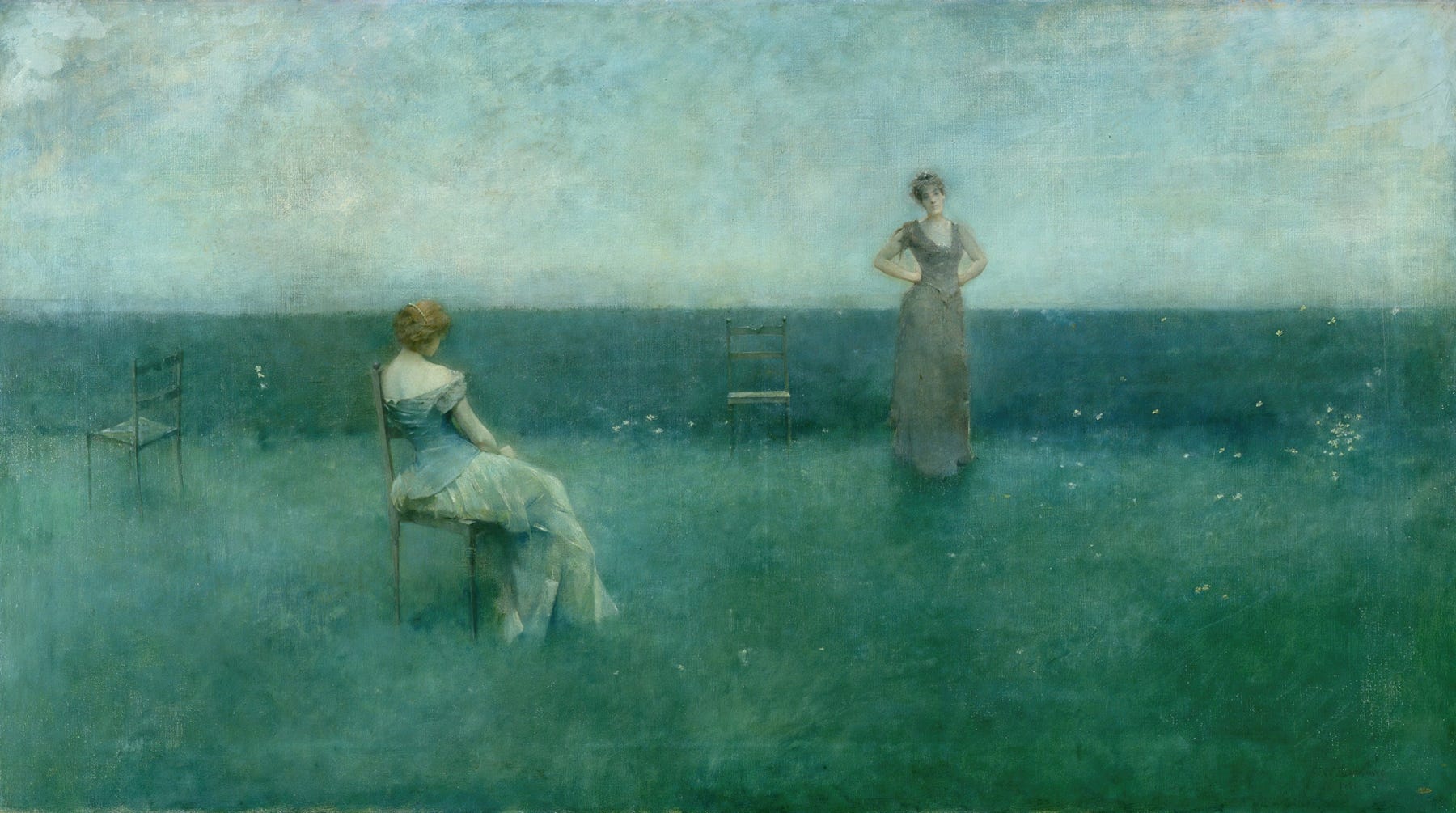
There is a shift this question requires, a clarity I want to be very specific about. I am not asking “What If I could witness that version of myself as true?” though I do think that is a crucial step in what I am writing towards. I’ve, at least to some extent, completed this step already—I know, I trust that the Jane that Anna is witnessing is true and honest and very, very real. I know that I can witness the doppelgänger, but what if I can witness from the doppelgänger? What if this is a piece of my subjectivity that I have abandoned? What if I could meet her in a dark room and perform the black magic of intimacy and become her, swap places in the night, re-emerge within the possibilities of a new self-perception both recognizable and unfamiliar? What if this intimacy—becoming the reflections that others return to us—is the path towards becoming radically altered versions of ourselves?
On some level this is an obvious conclusion: we are changed by the people we meet, the people we meet change us, intimacy is transformative. But again, there is something slightly more specific I think I’m trying to grasp, something to do with intention. Because even as it is a fact that those we know and love change us, there is so much constant small tragedy in the ways others seemingly don’t change us.
A few months ago, while at dinner with my parents, I brought up the Enneagram, a personality system that has become very important to my practice and helped shepherd me towards so much growth. (Poppy calls it “The Jane Bible”). To give the briefest overview, the Enneagram system begins by asking what an individual’s core wound is—by asking what deepest, oldest fear they carry with them—and traces a path outward, seeking to illuminate the ways that our responses to the fears we carry can form into a personality, the defense mechanisms that define our motion through the world. The system identifies nine basic wounds, corresponding to nine basic personality types—a system which, while inevitably a little reductive, in practice I have found to be surprisingly thorough. Each type is defined by a core fear, a core desire that responds to that fear, and a central self-belief that answers that desire. To use Type Six as an easily graspable example, the core fear of a Six is “having no support and guidance, being unable to survive on their own.” Their core desire is “to find security and support.” And their central self-belief is that they “are good or okay if they do what is expected of them,” resulting in a person who (when this woundfear is unaddressed) adheres adamantly to the systems of power they exist within, regardless of how well those systems do or don’t serve them.
As I was talking about this with my parents, I began to briefly run through all the types, quickly recounting the basic fears and desires that defined them—and when I got to Type 2, whose core fear is that they “are unworthy or undeserving of love,” immediately I saw a deep pang of recognition in my mother’s eyes, as simultaneously my father turned to look at her. She welled up with tears as soon as she started talking.
“That sounds just like me… I know your father loves me, I know he does, but to this day I still don’t understand why.”
There are very real consequences for the versions of ourselves that we fail to become, for the versions of ourselves held within the eyes of those who love us that we never truly witness. Not lives destroyed but lives left unlived. Joy left unfelt. Harm left unchecked.
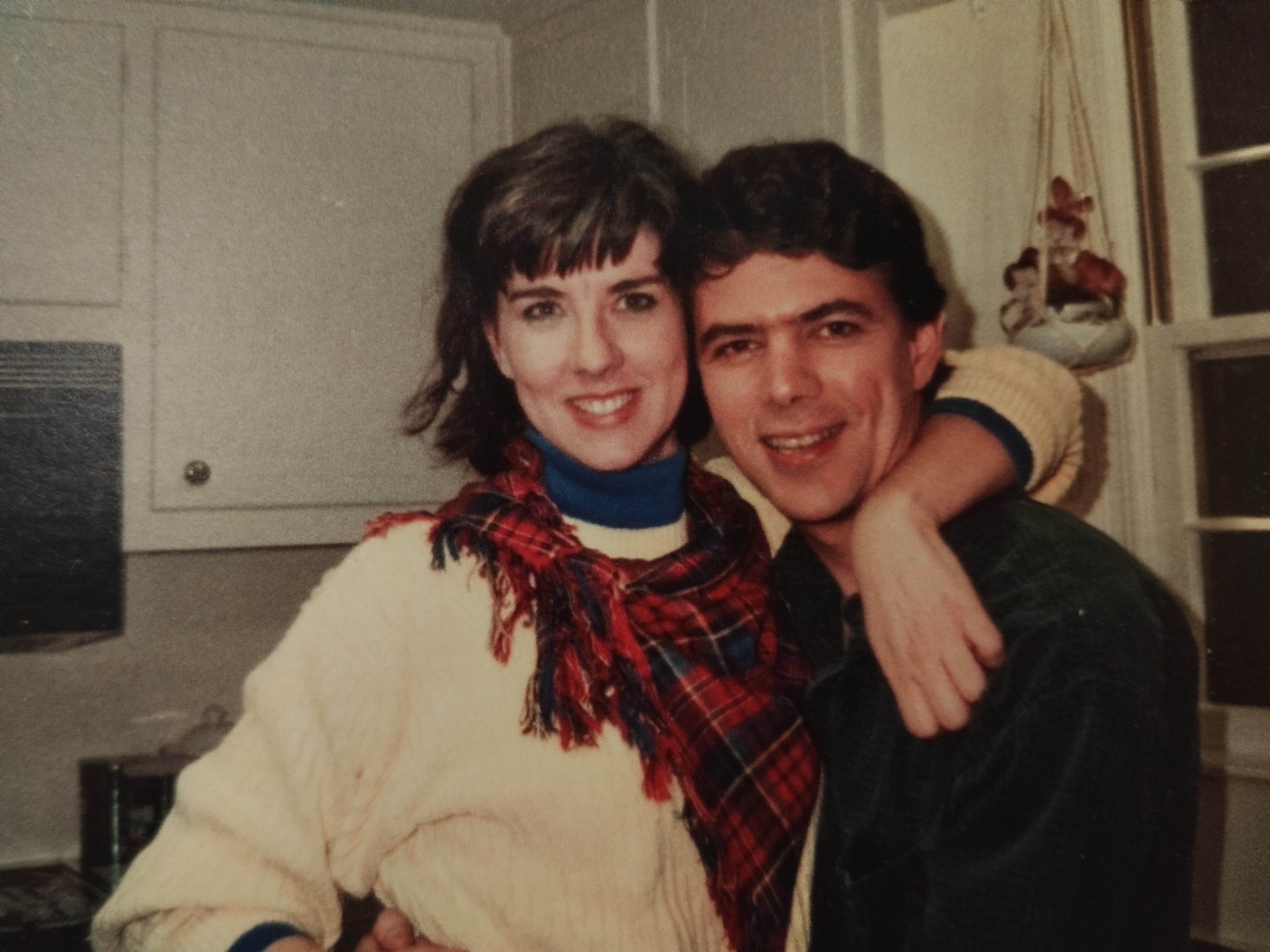
I know it is not the fault of my father that my mother can’t see herself from his love. He adores her, and she knows that. She has witnessed her doppelgänger, thoroughly and vividly and honestly, for the better part of four decades. But—and this is what I am really grasping at—she hasn’t merged with her doppelgänger, she hasn’t accepted her in, she hasn’t become her.
I, like my mother, am also a Type 2 on the Enneagram. I, like my mother, know myself well, am emotionally intelligent, am bright, and caring, and yet struggle, so often and so thoroughly, to grasp the simple truth of my own beauty. I, like my mother, am surrounded by family, friends, community who love and adore me, who witness me in all the complicated flaws that I am so quick to believe, and love me all the same, holding me in all my complicated beauty that I am so quick to dismiss.
What pieces of yourself aren’t contained within your subjectivity?
Every relation, every reflection in every pair of eyes, every witness, every perspective, every intricate holding, every changing care, every discovery, every becoming, every memory, every knowing, every precious knowing, is me. Precisely me. Jane does not reside within me, not alone. Jane is held by my community. Jane is an accumulation of everyone I have ever trusted to know me. I am contained by multitudes.
I return to the question. If these relational reflections, these doppelgängers, are fragmented shards of my subjectivity, pieces of my Self separated from me only by time and space and nervous system, what would it take—and I am not talking about a metaphor here—actually what would it take to perceive from within them? To reform the mirror from its shards? To integrate?
I intended to publish this piece a month and a half ago. And I know I could have done it if I had let myself end with that question: acknowledge the desire, scan the horizon, invoke the Law of Attraction, and put a bow on the whole thing and move on from it. But God, some part of me just wouldn’t let myself do that. I’ve been talking with Conner over the past few months about how the questions we ask are fundamentally more important to our growth than the answers we reach, and I do believe that. And I also know I know that what I’m writing in search of is the task of beliefs and religions, not girls with substacks, but—and maybe here is a beginning to an answer—I think the version of Jane I would like to be would try to answer the question anyway. Certainly that is what I would tell my students to do. If I really believe that I have the power to change myself, that I am more than a passive slave to economy, culture, and ancestral trauma—which god dammit Yes I Do—then desire simply isn’t enough. I said to Stephanie years ago that desire isn’t actually about its fulfillment, but about the motion it generates, about its reaching. The questions we ask are more important than the answers we reach, but only if we try to answer them. Maybe this is an impossible question, maybe I will die with this desire and maybe that doesn’t matter at all because god dammit I want to know her I want to see my own my own beauty so here we are again, and again, and again, what would it take??
All my first ideas are jokes or half-jokes, so let’s get those out of the way first. Psychedelics? Years of meditation? A trip to the Black Lodge? A frightening amount of naiveté? Join a monastery? Study the occult…?
The actual first answer has to be a displacement of the ego. An emptying, or at least a clearing of space inside the Self. There is no becoming without sacrifice—if the goal is to become someone else, or at least to integrate with them, that has to begin with making room. So, displacing the ego. Not a rejection of the Self, but a contextualizing. An understanding that the Self is a narrow vessel, a fraction of the truth, a limitation, a thing of beauty and bounty and power and yet itself a fragment of the wholeness that contains it. A single point in a diffuse field of meaning.
I’m very conscious here, as I write this, that what I am describing is the essential, first, and final task of countless belief systems: “He must increase, but I must decrease” (John 3:30, KJV), “The Shekhinah is in exile within the husks, for the will to receive has overcome the soul. Man must redeem Her by rising above the self.” (Etz Chaim), “For things to reveal themselves to us, we must be ready to abandon our views about them.” (Thich Nhat Hanh, Being Peace). Hardly a step one. But, in the same breath—and with attention, respect, and reverence to all the beliefs I cite and beyond them—this is the first step, even as it is also the final. A task undertaken not by completing it but by beginning it, once more and again, always and forever. “One must imagine Sisyphus happy.” (Albert Camus, The Myth of Sisyphus). I won’t presume to offer anyone clarity on how to walk this path—both because I have only barely begun to walk it myself and, again, ‘beliefs and religions not girls with substacks’—but the fact that the only first step I could think of towards the task in front of me (loving myself) is the first step towards any system of belief feels resonant and affirming. Maybe it is the wound shining through, but I feel so presumptuous as I try to answer my own question—who the hell do I think I am to pretend I have these answers? But if the path forward I am finding is the same path forward that has always been found, maybe the Enneagram is right. Maybe the path to God goes through the wound.
The second task, simultaneous to the first, is not a task at all but a premise: Community. Family. I cannot let in light that I do not receive. In order to become a reflection of myself, I first must see my reflection. And again, here is a lifetime of work, and a project far beyond my own power. There are endless forces in our world today—capitalism, globalism, fascism, colonialism, etc.—hellbent on holding us away from a genuine meeting and knowing of each other. Community should be a given in our lives—it is our birthright—but unfortunately and devastatingly that is not the world we were born into. I am not interested in defeatism here, though. If anything, this lack and need and violence we were born into demands that this task be extraordinary. Oh god, we have to know each other. And not know as in “have met,” but know—we have to see each other weep, build together, recreate our realities around the possibilities of our friends, tell each other when we are wrong, fight, write poetry about each other, actually show up as ourselves and not as the versions of ourselves we think systems of power want us to be. Maybe that community will be fifty people and maybe it will be three and I do not think it matters—what matters is that we let ourselves be witnessed. That we let our lights be seen so that others can reflect them back to us. Because if they can’t… oh there are other mirrors. Capitalism, Whiteness, Straightness, and all their friends have their own mirrors and they are already pointed at us. The stakes are very high, actually. If we do not meet ourselves in the eyes of those who love us, we will meet ourselves in the hatred of a system that wants to own us. We have to know each other. We have to be known.
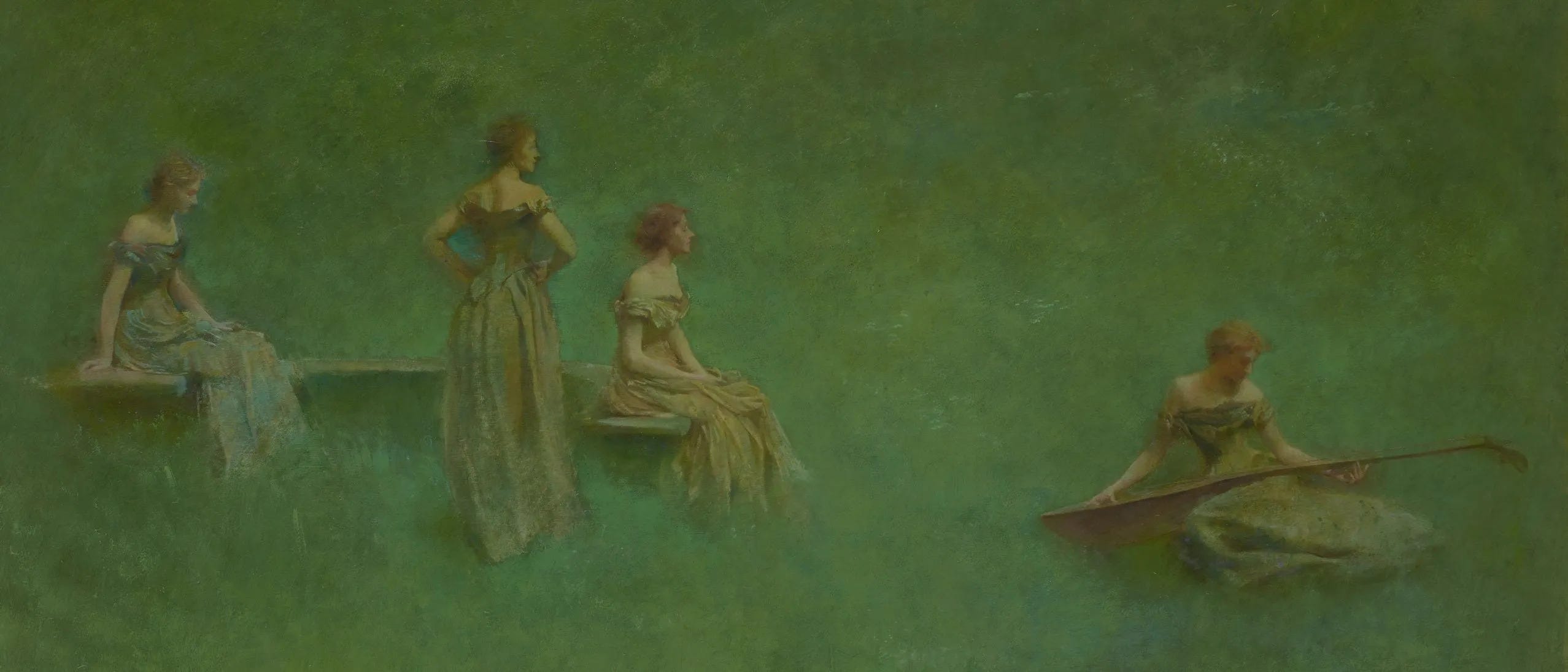
The connective tissue between these first two tasks is dense and fraught and I want to pause on it for a moment. Because in so many cases it is our very perceptions of ourselves—our egos formed by the hostile mirrors held up to us from birth—that prevent us from knowing others. We have been taught, maybe forced, to hate ourselves, or at the very least to view ourselves as deeply flawed, needing constant energy to maintain the image of our value. We are taught to live in shame for our perception of our own wrongness, or incorrectness, or deviation, or insufficiency. And for so many, certainly including myself at moments in my life, to let that self-hatred be witnessed is an absolute horror. So we hide the versions of ourselves that we perceive from, keep them tucked away behind masks, and know each other without ever breaking the surface tension. Acting more than interacting. Masking. Vanishing. But here is what I think is so crucial, and so complicated, and where I think the power lies in distancing the self from the reflection—the version of me that others will meet is not my Self. It never will be. Yes, if I hate myself then my friends will recognize my self-hatred, or my self-pity, or my regret or my anxiety or my fear or whatever it is, but they will not, they will never perceive me from those things. Not in the way that I do. Those things are contained within my Self, and my friends do not know my Self, they know my doppelgänger. And my doppelgänger is NOT my Self but it IS me and they LOVE ME. The Self doesn’t get to be known by anyone other than itself, that is the simple truth of it. No one will ever know my Self. And I have heard this truth often cited as a source of loneliness, imagining that “we will never truly know each other,” believing that the separateness of our perceptions forms an impassable ceiling to the intimacy we can possibly experience, fixating on the separation. But what I am beginning to realize is that this is actually the site of immense liberation: that my perception of myself is no more important to the wholeness of my being than the perceptions of those who love me—that maybe, just maybe, I actually don’t know myself better than Conner does, or Morgan, or my Mom—that this composite image, the re-assembled Jane formed from the perception shared by not just me but everyone in my community, if I can set my ego aside and witness from the spaciousness outside myself, even for just a moment, is knowable.
This is the third task. After making enough room in yourself to be filled, after meeting others earnestly enough to witness yourself reflected back, you have to receive the reflection. You have to meet your doppelgänger. Not just acknowledge your doppelgänger, not just recognize that they exist, but meet them, like you would meet a new friend, with curiosity and excitement. You aren’t getting to know yourself (your Self) in this moment, you’re getting to know this other person, a friend’s friend that they adore enough to tell you about. You have to listen when they talk about this person, receive the stories with excitement, get excited about their lives, interested in their gossip, enwrapped in their story. I’m veering towards metaphor here; let me try to say it in more grounded words. The third task is to see what your friends see, to witness yourself through their eyes of love, to hear those you trust speak to the truth of their perception (which couldn’t be anything other than true), and to believe them, even if the mirror they hold up to you is initially uncomfortable, or confusing, or scary, and to set yourself aside like you’ve practiced (because this isn’t your Self they’re describing, not yet), and to become enamored, excited about this person they’ve fallen in love with. Because they love you. And you deserve to know the person they love as much as they do.
So you meet yourself. So you get to know them. So you, slowly, across time, learn them better and better. There is a distance here at first. Intimacy takes its time, and knowing your doppelgänger is loaded in a way other relationships might not be. But you do it, because you trust your friends and their love for you. And eventually, as with anyone you spend enough time with, as with anyone you truly unapologetically open yourself to, yes, you arrive at intimacy. You might not see your doppelgänger as You, still, but you know them—you’ve seen them live a life, you’ve watched them move through hardship and through bounty, you’ve learned to trust their presence. And, importantly, you’ve begun to witness their parallels. They still aren’t you, but they don’t seem quite as different as they maybe used to.
Intimacy isn’t a resting place though, it is a passage. Where does it lead you?
There was a moment of closeness, years ago, with Tori, that I so often think back to as a teacher. She was back in Ann Arbor, visiting from Chicago where she lived at the time. We were standing across from each other in the music school lobby, maybe five feet apart. As we talked, I slowly began to notice that she was mirroring my posture, that quiet intimacy we often subconsciously slip into in conversation. Then I realized no actually, she was exactly mirroring my mannerisms, in real time, and she definitely knew it. She was copying me. I called her on it, laughing and asking her why she was doing that, assuming it was a joke. But she responded, “I’m trying to remember how you stand and talk so I can still have you with me when I have to go home.”
The way I adopt Conner’s phrases, constantly hear him speaking through my mouth, ask myself what he would think of every problem, sing the songs he sings when I’m away from him. The way I make jokes intended for Morgan when she’s half a country away and no one else fucking gets them. The way I wear my socks scrunched up at the ends of my feet like my mom, the way she cooks through my hands, the way she gives me advice without my needing to call, the way she holds me, is always holding me, even when she’s not there. The way Charlotte and Yaeger are constantly egging me on and feeding my energy, the way Veronica is bouncing with excitement from within my body, the way I feel Evan attentively listening whenever I teach. The way I am my father’s patience. The way I am my mother’s love.
I am already a reflection of all those who love me—they are coursing through my blood, every moment of every day. Intimacy is already itself a fusion, an allowance, an opening, a welcoming. “Here I am. Come inside.” Maybe there isn’t black magic at the end of this journey. Maybe my Self remains my Self, maybe I don’t escape the walls of my own perception. But why should that mean that I can’t let others’ love for me enter me? What if I loved my doppelgänger like I do my family? Why can’t I have this reflective intimacy with myself?
This question, unlike the first few, has an easy answer. I can.
To receive those that I love into my body—which I will, which I do—is to receive myself—which I must. I don’t get to perceive from the Jane that Anna knows, but I do get to perceive with her. I can hold her in my body. I can reflect her. I don’t have to feel as self-assured as Anna thinks I am, but I can know, really actually know, not in my brain but in my body, that Anna sees that in me, and that she is right, utterly and undeniably, and I can call on that version of myself to inhabit me as a companion, as I would anyone that I love. Because that is the fourth task. To love the versions of yourself that you don’t understand. To learn, slowly, to accept the love you receive not with confusion, not with dismissal, but with reciprocity. To let those who love you fill you.
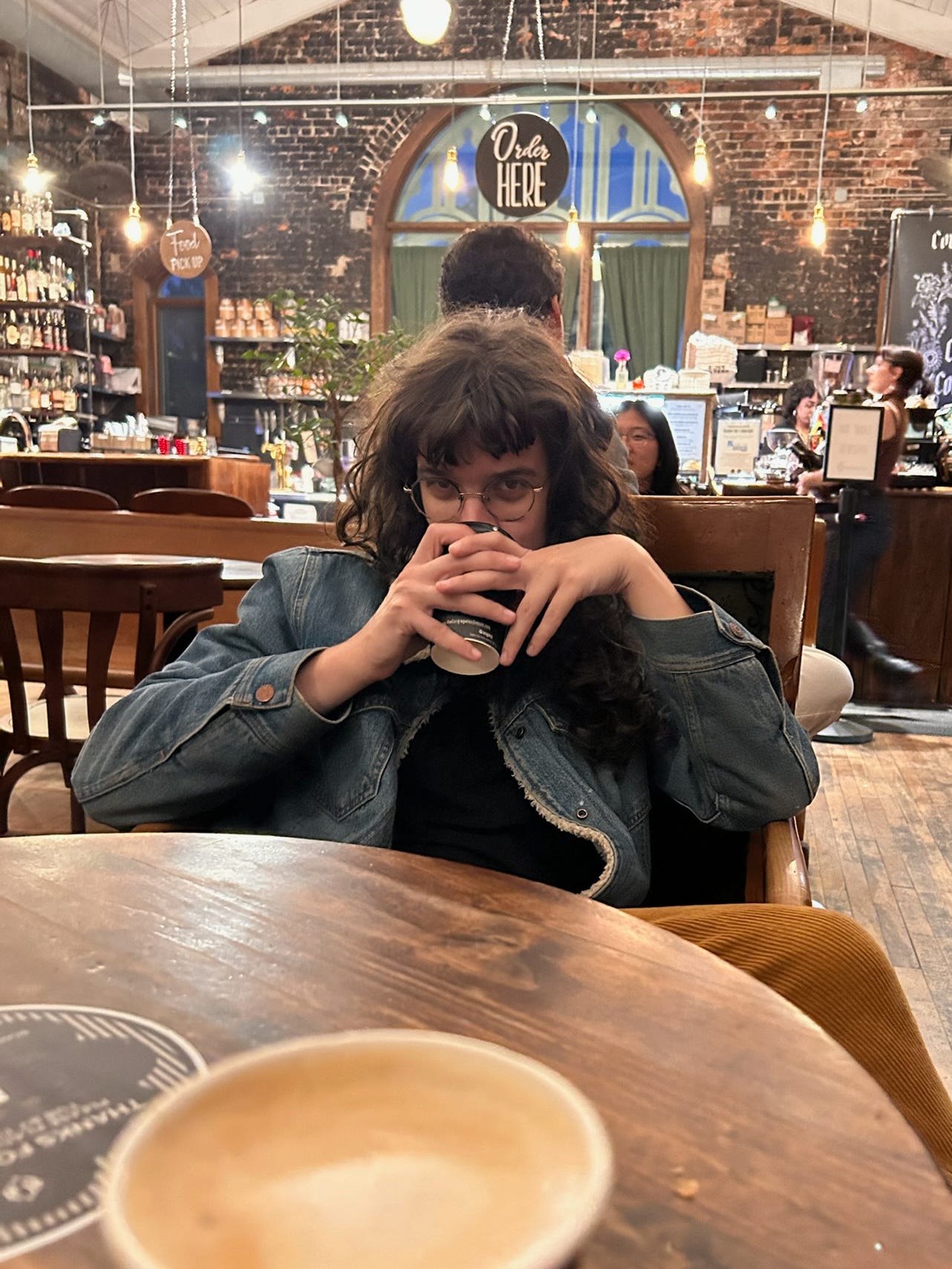
Even this feels like a beginning, not a conclusion. As if this journey is simple. As if the path is drawn out and now I just have to walk it. But I feel easy in this arrival, in a way I didn’t when I began. I feel gentle, I feel comfort—and not the comfort of stability but the comfort of trust. I still have so many questions, as I try to draw this path out for myself—what about all those doppelgängers that are less flattering, less kind?—and I certainly have work to do in putting all this into practice, though I have already felt my relationship with myself change in small ways as I have been writing this. All that is for a different substack, though. Thank you for being here. If anyone has thoughts they would like to share I would love, love, love dialogue about this. Grateful to you all as always.
xoxo
Jane
I love how you’ve articulated this whole train of thought(s). A lot of what I wrote in my college thesis was very centered on this idea of the self and our reflections, how they coincide and diverge, how they can feel so separate but are in a way, the same. Thanks for posting these musings, Jane. I always thoroughly enjoy them <3